
Federal grants audit delayed for the third time
Posted on 11 Nov 2026
A detailed report into federal grants by the Commonwealth auditor has been delayed again and is now…
Posted on 11 Nov 2026
By Denis Moriarty, group managing director, Our Community

Every jurisdiction in Australia has an Auditor-General, and each one produces detailed reports every year examining how governments spend public money.

Over the past decade alone, there have been at least 66 major audits of government grants across the Commonwealth and every state and territory. Together they represent a comprehensive examination of public grant administration in Australia, identifying recurring problems in governance, transparency, performance measurement, data quality and accountability.
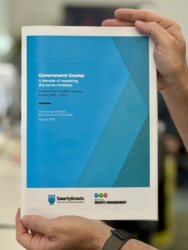
The Institute of Grants Management (IGM), our grants education and research arm, commissioned a white paper to review all of these audits. And what it found is that nothing much has changed. Governments today are struggling with the same issues they identified a decade ago. They distribute more than $100 billion each year and see countless recommendations for improvement, yet the same themes continue to emerge: poor data, weak evaluation, inconsistent governance, inadequate post-award monitoring and limited capability in grants administration.
I recognise this pattern because I spent years inside the system. As a Deputy Secretary of a government department, I was responsible for grants programs, and I also oversaw the department's media and communications unit, which was fortunate for me. Whenever an Auditor-General's report arrived, the departmental response followed a familiar script. We welcomed the report, accepted the recommendations, acknowledged there were lessons to learn and reassured everyone that public money was always being managed to the best of our ability. The media release was drafted, the Minister was briefed, a few interviews were conducted, and before long, everyone moved on. Recognise the script?
The uncomfortable truth is that very little fundamentally changed. A year or two later another audit would appear, examining a different grants program but identifying many of the same weaknesses. Documentation was inadequate. Assessment processes lacked transparency. Outcomes had not been measured. Decision-making wasn't always well recorded. It became a cycle in which reports generated responses, responses generated action plans, and action plans generated yet more reports.
That wasn't because public servants were incompetent or because Auditor-General recommendations lacked merit. More often it reflected the realities of government. Ministers wanted announcements before the end of the financial year. Funding had to be committed quickly. Programs were frequently handed to capable policy officers, and in some cases, to complete incompetents, who had little experience in grants administration but happened to be available. Decisions were made under political and budgetary pressure, and success was often measured by whether the announcement generated favourable headlines and by the absence of front-page stories of misuse of government grants funding, rather than by whether the funded project achieved lasting public value.

"The problem is no longer the absence of good policy. It is the gap between those frameworks and what happens when ministers want programs delivered quickly, agencies face staffing pressures, and grant teams are trying to administer increasingly complex programs with limited or no capability."
Perhaps the biggest failure was that we rarely measured outcomes in any meaningful way. Once the grant agreement was signed, the real objective had often already been achieved: The announcement had been made, the money had left the department and the political commitment had been honoured. Whether the funded organisation actually delivered better services, stronger communities or improved economic outcomes frequently became a secondary consideration, even a minor one. By the time the Auditor-General came knocking 12 or 18 months later, attention had already shifted to the next funding round and we were out of the spotlight.
Our white paper makes the important observation that Australian governments have become far more digital over the past decade without necessarily becoming more accountable. We have invested in grants management platforms and standardised templates and digital workflows, yet auditors continue to identify incomplete records, inconsistent data, poor evaluation and limited evidence of outcomes. Technology has undoubtedly improved administration, but technology alone cannot fix a system whose incentives remain focused on spending money rather than demonstrating public value.
We cannot argue that governments simply lack guidance. One of the white paper’s strongest findings is that every jurisdiction now has a comprehensive grants framework built on transparency, proportionality, risk management and outcomes. The problem is no longer the absence of good policy. It is the gap between those frameworks and what happens when ministers want programs delivered quickly, agencies face staffing pressures, and grant teams are trying to administer increasingly complex programs with limited or no capability.
There are some encouraging signs. New South Wales, for example, has invested in a whole-of-government grants management platform (which my company supplied) that embeds many good-practice principles directly into the software rather than relying solely on policy documents and guidance. That may ultimately prove more significant than another set of recommendations, because better systems can reduce the opportunities for poor practice before they occur. The challenge for every jurisdiction is whether they are prepared to invest not just in another review, but in changing the systems that continue to produce the same findings.
Auditors-General perform an essential role in Australian democracy. Their reports protect public money, improve accountability and strengthen public trust. But after reading 10 years of remarkably consistent findings, I realise that Australia has no issues identifying what is wrong in grantmaking. Our real problem is whether governments are genuinely prepared to learn from what they already know. Until that happens, we should not be surprised if the next decade of Auditor-General reports looks remarkably like the last.
Denis Moriarty AM is the founder and group managing director of Our Community. Previously, he was head of the Victorian government’s Information Service, MD of Strategic Australia and commissioner, and deputy CEO of the Victorian Tourism Commission.
Posted on 11 Nov 2026
A detailed report into federal grants by the Commonwealth auditor has been delayed again and is now…

Posted on 11 Nov 2026
For many people, ESG sounds like corporate and business jargon. For not-for-profits it might be the…

Posted on 11 Nov 2026
A funder uses AI to help design a grant program. An applicant uses AI to write an application. An…

Posted on 03 Aug 2026
A decade of Australian auditor-general reports shows grantmakers and decision makers repeatedly…

Posted on 25 Jun 2026
Australia distributes an estimated $125 billion in grants annually, but grantmaking, unlike…
Posted on 25 Jun 2026
The federal government's Community Sector Grants Engagement Framework is "on track," the Department…
Posted on 25 Jun 2026
Australia’s grants administration system has centralised bureaucracy instead of expertise, creating…

Posted on 25 Jun 2026
Nine in 10 Australian social impact measurement practitioners are now using AI in their work, but…

Posted on 24 Jun 2026
More than 300 of Australia’s top social impact professionals and leaders will gather in Sydney on…

Posted on 03 Jun 2026
A new report has found that ongoing financial, workforce and governance pressures mean the…

Posted on 20 May 2026
The Australian National Audit Office (ANAO) has released a new report in its Audit Lessons series,…

Posted on 20 May 2026
The NSW government's administration of a flood recovery grants program has largely met requirements…