
Same failures, different decade: white paper calls for new tactics to prevent grantmaking mistakes
Posted on 03 Aug 2026
A decade of Australian auditor-general reports shows grantmakers and decision makers repeatedly…
Posted on 03 Aug 2026
By Matthew Schulz, journalist, Institute of Grants Management
A decade of Australian auditor-general reports shows grantmakers and decision makers repeatedly making the same mistakes, a white paper just published by the Institute of Grants Management (IGM) shows.
The report argues the sector has what it needs to break the costly cycle.
The IGM, part of the Our Community group, reviewed 69 performance audits published by the Australian National Audit Office (ANAO) and every state and territory auditor-general in the decade to 2025, examining a sector that distributes around $150 billion a year.
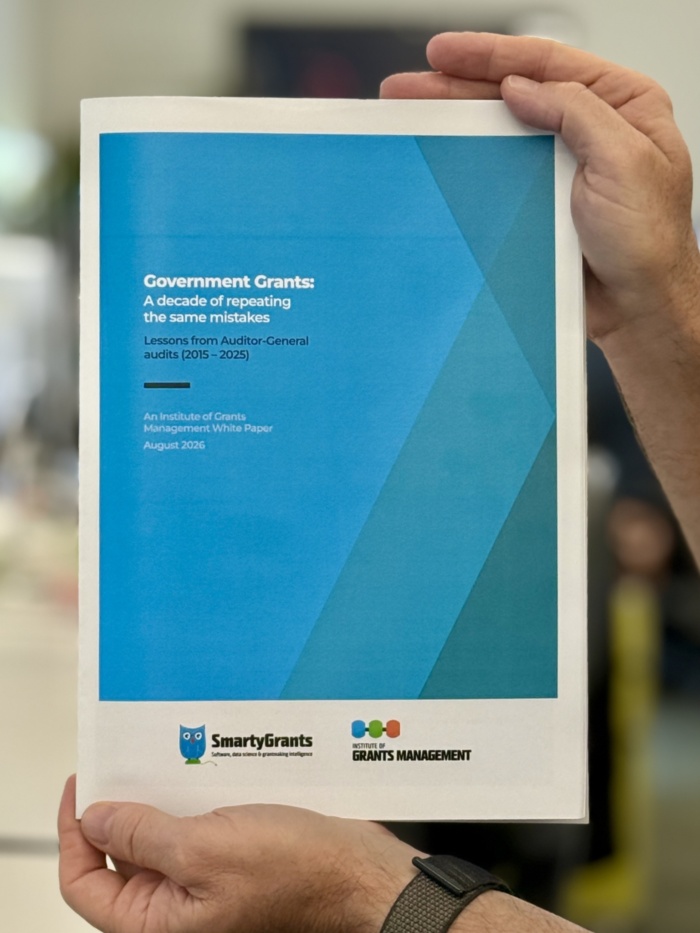
The 34-page report, Government Grants: A decade of repeating the same mistakes, distils those findings into themed insights and proposed actions, and suggests the sector must take collective action.
"If auditors keep raising the same issues, we should treat those issues not as isolated failings of individual program administrators but as structural features of the Australian grantmaking ecosystem," the report says.
Our Community Group managing director Denis Moriarty said it was hard for grantmaking agencies to avoid auditor scrutiny altogether, but the white paper did not seek to single out the programs or agencies discussed in auditors’ reports for blame.
“In a sector that distributes billions, some level of audit criticism is inevitable. The important question is whether the sector learns from recurring findings or continues to repeat the same mistakes."
“After more than two decades working at the intersection of grantmaking practice, technology and sector reform, we’ve got a good handle on how grants are designed, delivered and managed”.
Nearly one-third of the findings and risks identified across the decade were linked to two key areas: data integrity and performance evaluation, with missing data, weak indicators and unreliable reporting recurring themes. Governance and oversight, post-award monitoring, and the transparency and fairness of grants were also frequently mentioned.

While new technology has improved efficiency, the report found that "Australian grantmaking has become more digitised without always becoming more accountable” and that "technology has improved visibility, but not necessarily governance discipline."
The report found that grants administration "often operates across partially implemented enterprise platforms, local systems and spreadsheets, creating 'shadow records' … and an incomplete whole-of-government view."
For instance, the Northern Territory's 2022 audit of grant management found that agencies had only partially adopted the GrantsNT platform and some continued to rely on Excel, warning that "this dual-track approach increased audit and control gaps".
The report framed the overall trajectory of grantmaking as "a shift from low-tech opacity to digitised opacity: governments invested in platforms, hubs, and central registers, but did not consistently enforce system use, harmonise data standards, or build validation and probity controls into everyday practice".

“The answer isn't another framework sitting on a shelf. It's embedding better grantmaking into the way programs are designed, assessed, managed and evaluated."
"Performance evaluation remains the weakest element of grant administration, with many audited programs unable to demonstrate whether funded activities achieve their stated policy objectives, opening grantmakers up to reputational, probity and sustainability risks, and wasting precious funds," the report found.
One example was the the Ethanol Production Grants Program, which ran for more than a decade before clear objectives and outcome measures were set, meaning "the environmental and regional development benefits of almost $900 million in expenditure could only be assessed as modest and high-cost in hindsight".
Transparency and fairness are described in the report as "persistently weak points in grantmaking practice, with non-competitive funding, inadequate documentation and discretionary overrides recurring over more than a decade of audits." Non-competitive processes, the report finds, "have been normalised rather than reserved for genuinely exceptional cases".
For instance, in the three years to 2019, around 90 per cent of funding under the Indigenous Advancement Strategy's Children and Schooling Program, and 95 per cent of funding under the strategy’s Safety and Wellbeing Program, was allocated non-competitively, "often to the same providers, entrenching incumbency and limiting innovation". And a 2021 review of Australian Government Grants Reporting found 42 per cent of Commonwealth grant funding went through closed, non-competitive selection, and a further 19 per cent through variations to existing awards, "indicating that such practices are a structural rather than exceptional feature of the system".
Governance and oversight arrangements across jurisdictions are "characterised by partial standardisation, uneven implementation of controls, and repeated calls for stronger whole-of-government coordination".
The report suggests the use of government “standardisation” as one of the clearest levers available to reduce risk, within limits: "Standardisation reduces risk, but only when agencies consistently apply common processes, templates and controls."
Across the decade, the audits on which the report draws trace "a shift from isolated, program-specific governance failures towards broader attempts at centralisation and standardisation," through platforms such as the Northern Territory's GrantsNT and guides such as the NSW Grants Administration Guide.
But the report finds the shift has "progressed unevenly and remains an ongoing challenge". While every jurisdiction now has a framework and those "create a clearer baseline for standardisation", "oversight remains patchy where entities can opt out, where machinery-of-government changes are not matched by governance updates, or where central policies lack strong enforcement". The report sums up the trend as "one of converging design but still fragmented execution".
The authors are cautiously optimistic, though, noting that "government standardisation efforts have accelerated across Australian jurisdictions in recent years".
The report argues strongly for building shared systems once rather than solving the same problem program by program: "central templates, core data fields and shared training help mitigate systemic weaknesses while reducing effort for program teams and grantees."
Acquittal and post-award monitoring show a similar pattern of good intentions outrunning practice, being characterised by "delayed, incomplete or low-evidence processes limiting assurance that funds are used as intended".
On workforce capability, the report quotes Queensland's 2024 status report on auditor-general recommendations, which is indicative of other risks, warning that "workforce limitations, outdated recruitment, [and] insufficient upskilling" pose a risk to future capability and service delivery, particularly for smaller agencies.
The report's central finding is that the problem is no longer a lack of rules. Every Australian jurisdiction now has a grantmaking framework covering data, evaluation, transparency, governance and acquittal, and the report finds "policy and frameworks now articulate many of the lessons found in the early period of 2015–2018," while "audits from 2022–2024 show partial and uneven implementation of these findings and recommendations." On transparency specifically, it concludes that "the primary issue is not the absence of rules but the uneven adoption of their spirit."
The report lays out recommendations rather than a compliance checklist.
"Audit reports are designed to highlight gaps in processes and procedures, not catch grantmakers out and impose punishment," it says, urging grantmaking teams to focus "on ensuring you are building towards better practice grantmaking, rather than avoiding getting in trouble".
It distils its findings into five principles:
There is a series of recommendations for both Commonwealth and state and territory grantmakers, with the report suggesting:
Moriarty said the key message of the white paper was that the sector need not start from scratch, because the findings of the past decade had already highlighted the key risks and the path to better practice.
“The answer isn't another framework sitting on a shelf. It's embedding better grantmaking into the way programs are designed, assessed, managed and evaluated.
“That's the philosophy that has guided the development of SmartyGrants over the past two decades. We built it not simply to digitise grant administration, but to operationalise better grantmaking and minimise risk.
“When good practice is built into the systems people use every day, transparency improves, risks are reduced, and better outcomes become much more likely.”
Posted on 03 Aug 2026
A decade of Australian auditor-general reports shows grantmakers and decision makers repeatedly…

Posted on 25 Jun 2026
Australia distributes an estimated $125 billion in grants annually, but grantmaking, unlike…
Posted on 25 Jun 2026
The federal government's Community Sector Grants Engagement Framework is "on track," the Department…

Posted on 25 Jun 2026
Australia’s grants administration system has centralised bureaucracy instead of expertise, creating…

Posted on 25 Jun 2026
Nine in 10 Australian social impact measurement practitioners are now using AI in their work, but…

Posted on 24 Jun 2026
More than 300 of Australia’s top social impact professionals and leaders will gather in Sydney on…

Posted on 03 Jun 2026
A new report has found that ongoing financial, workforce and governance pressures mean the…

Posted on 20 May 2026
The Australian National Audit Office (ANAO) has released a new report in its Audit Lessons series,…
Posted on 20 May 2026
The NSW government's administration of a flood recovery grants program has largely met requirements…
Posted on 07 May 2026
A Tasmanian parliamentary inquiry has heard new evidence that the state's Department of Health has…

Posted on 07 May 2026
A fast-growing region of New Zealand – home to the world’s best adventure tourism, awe-inspiring…
Posted on 07 May 2026
Organisers of Blak Loungeroom, a historic Indigenous-led philanthropy conference held in Melbourne…